Drawing Supplies
Graphite Pencil Grades Explained: The H and B Scale
Published February 22, 2026 · Updated March 12, 2026 · 8 min read
What the letters actually mean
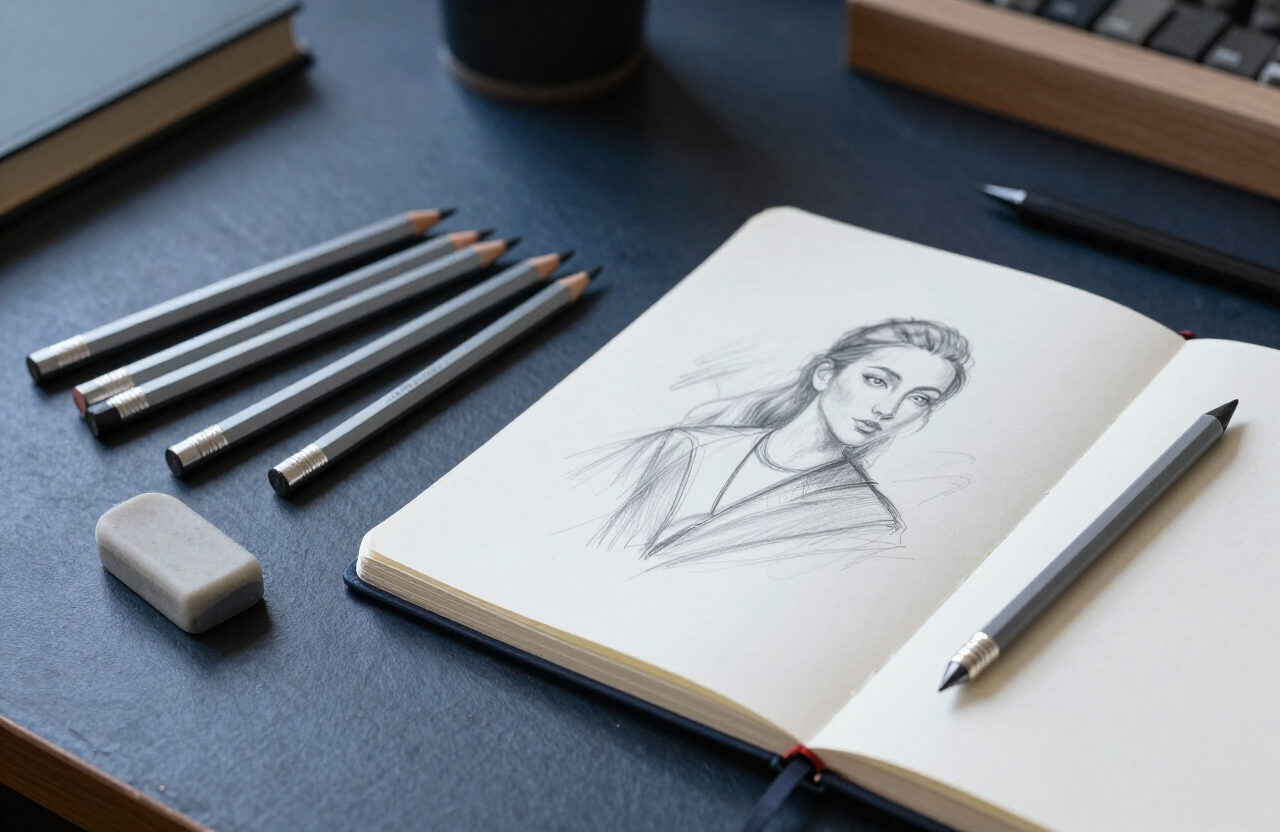
The H stands for hardness and the B for blackness. The graphite core of a pencil is a mix of graphite powder and clay: more clay makes a harder, paler mark (the H side); more graphite makes a softer, darker mark (the B side). HB sits in the middle. A number in front tells you how far the pencil leans — 2H is harder than H, 6B is softer and darker than 2B.
The scale runs from 9H at the pale, hard extreme through HB to 9B at the soft, dark extreme. American #2 pencils are roughly an HB. Once you understand that the grade is just a clay-to-graphite ratio, the wall of pencils stops being intimidating.
The scale is not as even as it looks
A common assumption is that the jump from 2B to 4B equals the jump from 4B to 6B. It does not. The B end of the scale compresses: the difference between 6B and 8B is smaller, in practice, than the difference between B and 2B. Manufacturers also grade by their own internal standards, so a Faber-Castell 2B is not identical to a Staedtler 2B — close, but not interchangeable if you need exact tonal matching.
This is why mixing brands in a single drawing can produce odd results. For consistent tone within a piece, stick to one brand until you have a reason to switch.
Which grade for which stage of a drawing
A finished drawing is usually built in layers, and different grades suit different layers. Use an H or 2H for the faint construction lines you want to disappear into the final image. Use HB for the bulk of the drawing — the shapes, proportions, and mid-tones. Use 2B to 6B for the darks, shadows, and final accents that give the drawing punch.
Trying to force a hard H pencil to go dark just embosses and damages the paper. Trying to erase a 6B construction line smears graphite across the page. Match the grade to the job and the drawing gets easier.
The grade almost everyone overrates
Beginners love the darkest pencil in the tin — usually an 8B or 9B — because it feels dramatic. But the softest grades are the hardest to control: they crumble, smudge at a touch, and lay down so much graphite that you cannot layer over them. Most professional drawings reach their darkest darks with a 4B or 6B, not an 8B.
If you are just starting, treat anything above 6B as a specialty tool for occasional accents, not your everyday pencil. Our best drawing pencils for beginners guide names the set that gets this balance right.
Frequently asked questions
Keep reading
Drawing Supplies
Best Drawing Pencils for Beginners: What to Actually Buy
You need three or four pencil grades, not twelve. This guide names the sets worth buying, the grades that actually matter for beginners, and where the marketing stops and the drawing starts.
Read the guide
Drawing Supplies
Best Art Supplies for Beginners: The Honest Starter Kit
A complete, tested beginner art kit for under $100 — plus the five products beginners should never buy, and the upgrade order that makes every dollar count.
Read the guide
Drawing Supplies
Best Sketchbooks for Artists: Tested Picks for Every Medium
We filled, soaked, and abused a shelf of sketchbooks to find the ones worth your drawings — organized by medium, with the paper specs that actually matter.
Read the guide